Most men who look into penile traction therapy fall into one of two camps.
The first group dismisses it immediately because it sounds too unconventional to be real. The second group buys a device, uses it for a few weeks without seeing visible changes, and gives up, convinced it doesn’t work.
Both groups are missing the same thing: a clear understanding of biology.
The mechanism is not unique to the penis. It’s the same fundamental process that allows surgeons to grow new skin for burn grafts, orthopaedic doctors to lengthen bones in children, and physical therapists to increase the range of motion after scar tissue forms. The gap in understanding is the actual reason most protocols fail. Let’s fix that.
What Is the Tunica Albuginea and Why Does It Determine Everything?
The tunica albuginea is the structural skeleton of the penis, and it is the only tissue that traction directly targets.
The penis contains two cylindrical chambers called the corpora cavernosa. These fill with blood during an erection and determine both rigidity and size. Wrapped tightly around these chambers is the tunica albuginea, a dense fibrous sheath that controls how much the organ can expand, how rigid erections become, and whether the shaft curves in any direction.
Its composition:
| Component | Share | Role |
| Type I collagen fibres | 95% | Structural rigidity; arranged in two layers — outer longitudinal, inner circular |
| Elastin fibers | 5% | Temporary stretch under pressure |
Crucially, this tissue is not static. Like all connective tissue in the body, it responds to mechanical inputs:
- Apply sustained compression, and it tightens and shortens
- Apply sustained tension, and it remodels, lengthens, and generates new cells
This responsiveness is what makes penile traction therapy biologically plausible. The target tissue is collagen-rich connective tissue, and collagen remodelling under mechanical force is one of the most well-documented processes in human physiology.
How Does a Traction Device Actually Apply Force to Internal Tissue?
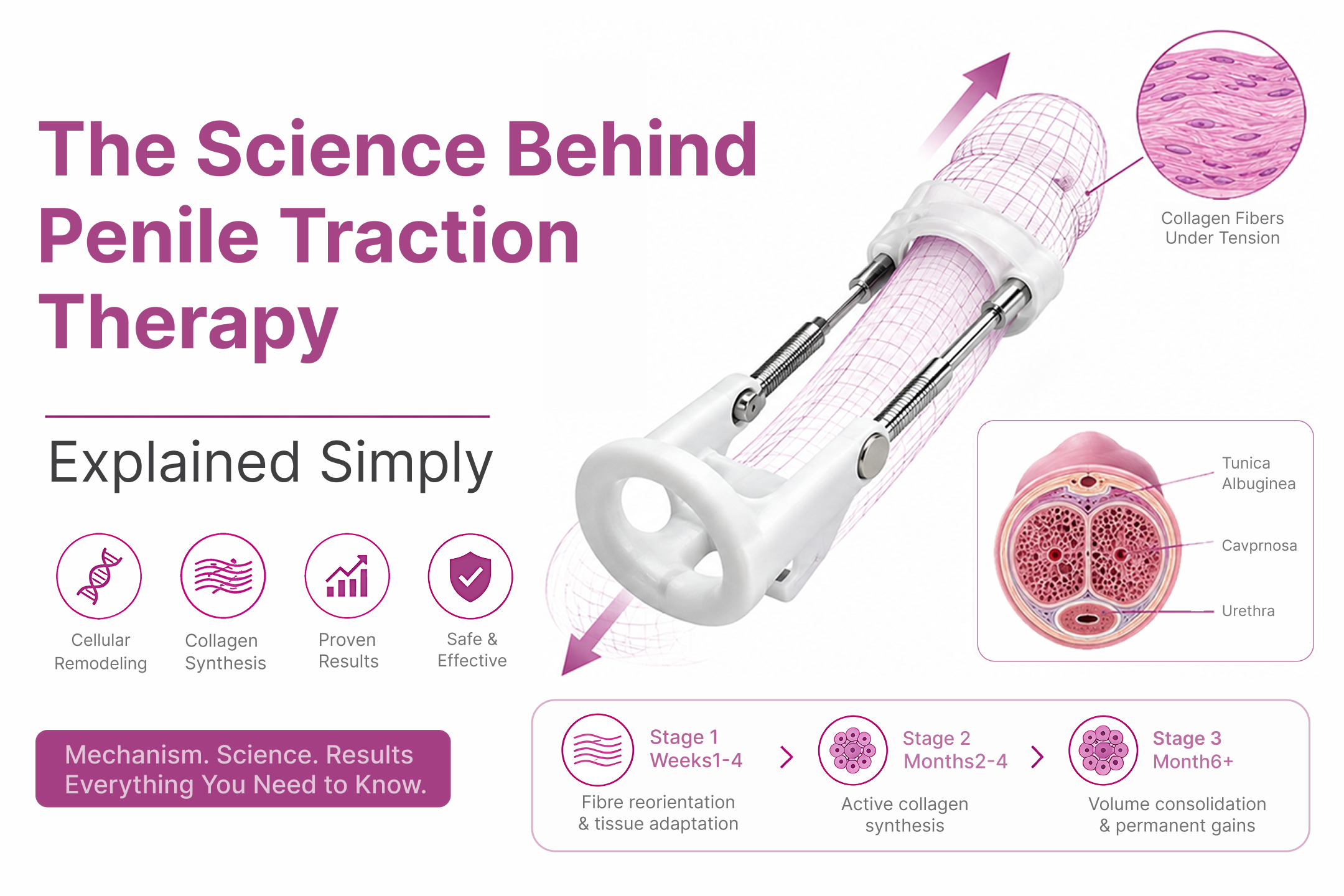
A traction device works by creating a calibrated, sustained stretch between two fixed anchor points on the penis.
The three-component structure every device shares:
- Base ring: Anchors against the pubic bone, acting as a counterforce so tension pulls the shaft, not the entire penis, away from the body
- Adjustable extension rods: Two rods run along either side of the shaft and create the traction; as tissue adapts, longer rod inserts maintain the stretch
- Headpiece: Grips just below the glans and transmits the pulling force from the rods to the penile shaft; designs vary by device — noose strap, double-strap DSS system, or vacuum cup
When the user clicks on a slightly longer rod segment, the distance between the base ring and headpiece increases by a small increment. The tissue between those two anchor points goes under stretch.
The force is deliberately gentle:
| Phase | Typical tension range |
| Starting point | Around 600 grams |
| Progressive target | 1,200 grams or more over months |
The goal is not to tear tissue. It’s to place it under the minimum sustained tension required to trigger a cellular response — and hold it there.
What Is Mechanotransduction and Why Is It the Core of How Traction Works?
Mechanotransduction is the process that makes penile traction therapy biologically real — not just mechanically real.
It is how cells detect mechanical force and convert it into chemical signals that change cell behaviour. It is how the body knows a bone is under load and should strengthen, how tendons thicken in response to exercise, and how skin stretched over a tissue expander generates new skin cells.
Here’s what happens inside the tunica albuginea under sustained tension:
- Fibroblast cells detect the mechanical force through surface proteins
- Those proteins transmit the signal inward to the cell’s nucleus
- The nucleus activates genes responsible for producing more collagen, more extracellular matrix proteins, and more cell-division activity
One in vitro study of cells derived from the human tunica albuginea found that mechanical strain caused a measurable increase in structural proteins, including smooth muscle actin, beta-catenin, and Hsp47 — all markers of active tissue remodelling.
Two processes run in parallel as a result:
| Process | What happens |
| Collagen remodeling | Existing fibres reorganise and align along the direction of applied tension |
| Cellular proliferation | New cells are produced to fill the expanded volume |
This is not swelling. Not temporary elongation. Not a placebo effect. It is a documented, measurable biological response to mechanical input replicated across multiple tissue types and decades of medical research.
How Does New Tissue Actually Form During Traction?
New tissue forms in stages — and understanding the sequence explains why early results feel invisible and later results feel sudden.
Stage 1 — Weeks 1 to 4: Fibre reorientation. Existing collagen fibres lengthen and reorient along the direction of tension. The user may notice slightly increased flaccid hang, but no permanent structural change yet.
Stage 2 — Months 2 to 4: Active collagen synthesis. Fibroblasts ramp up collagen production and extracellular matrix deposition. New structural tissue is laid down parallel to the axis of stretch. Measurable flaccid length changes typically begin here.
Stage 3 — Month 6 and beyond: Volume consolidation. The volume of connective tissue genuinely increases. The tunica accommodates a longer, more expanded state as its new resting architecture. This is what makes gains permanent.
For Peyronie’s disease specifically, traction does something additional. The fibrous plaques responsible for curvature are also disorganised collagen. Sustained tension triggers increased production of collagenase and metalloproteinase enzymes, which break down scar collagen and allow replacement with more normally organised tissue. This is the mechanism behind curvature reductions documented in clinical research.
What Does the Clinical Evidence Actually Show?
The evidence is more substantial than most men realise — and more modest than most marketing suggests.
| Study | Device | Protocol | Key outcome |
| BJU International, 2009 | Andro-Penis | 4 to 5 hours per day for 6 months | Flaccid length up 32% (7.15 cm to 9.45 cm); erectile function scores up 36% |
| ScienceDirect, 2011 | Golden Erect | 4 to 6 hours for 2 weeks, then 9 hours daily for 3 months | Stretched length increased significantly (P < 0.05) |
| BJUI pilot study | Jes-Extender | 6 months of daily use | Flaccid length up 2.3 cm; stretched length up 1.7 cm; erectile function significantly improved |
| Mayo Clinic RCT, 2021 | RestoreX | 30 to 90 minutes daily post-prostatectomy | +1.6 cm vs. +0.3 cm in controls at 6 months (P less than 0.01) |
| Cureus narrative review, 2025 | Multiple devices | 15 major studies, 1,000-plus patients | Average curvature reduction of 25 degrees; mean length gains of nearly 2 cm; adherence above 85% |
The consistent pattern across all studies:
- Flaccid length gains are the most reliable outcome
- Stretched penile length follows
- Erect length gains are real but smaller in percentage and slower to show
- Girth gains from traction alone are minimal and inconsistent
The European Society for Sexual Medicine acknowledges that traction shows promising results for Peyronie’s disease, with curvature reductions ranging from 4 to 31 degrees across studies. Larger randomised trials are still needed. But the directional consistency across 15-plus independent studies spanning multiple device types and patient populations is the reason traction therapy has entered mainstream urology practice.
Why Does Traction Therapy Also Improve Erection Quality?
Erection quality improvements from traction are not a bonus. They are mechanistically connected to the same process driving length gains.
Erections work through the nitric oxide and cyclic GMP pathway:
- The brain signals arousal
- Nerve endings and endothelial cells in the corpora cavernosa release nitric oxide
- Nitric oxide activates guanylyl cyclase, which produces cGMP
- cGMP causes smooth muscle relaxation in penile blood vessels, allowing dilation and blood flow
- The tunica albuginea tightens under pressure, compressing veins that drain blood out
- The result is a firm erection
Traction therapy upregulates endothelial nitric oxide synthase (eNOS) — the enzyme that produces nitric oxide in blood vessel walls. Higher eNOS activity means:
| Effect | Outcome |
| More nitric oxide signal | Better vessel dilation |
| Improved blood flow | Stronger erections |
| Vascular stimulation | Tissue remodelling runs simultaneously |
This explains why clinical studies consistently report better erectile function scores alongside length increases. It is a consequence of the same vascular stimulation driving structural change — not a coincidence.
How Many Hours Per Day Does Traction Therapy Actually Require?
Four to six hours of daily wear is the evidence-based minimum for meaningful tissue remodelling. That’s the honest answer most reviews avoid because it isn’t convenient.
What the published studies actually required:
- BJU International study: participants averaged 4 to 5 hours per day over 6 months
- Golden Erect study: 4 to 6 hours in the first phase, then 9 hours daily
- Multiple device-specific studies: 1.5 to 5 hours per day, with larger gains consistently associated with longer sessions
The biological reasoning is straightforward. Mechanotransduction is not an instant switch:
- Short sessions create a brief stretch and release — tissue adapts by becoming transiently more elastic, not by generating new volume
- Only when tension is maintained across several consecutive hours do fibroblasts ramp up protein synthesis and cell division in the way clinical studies describe
A device that cannot be worn for several hours a day is clinically inert, no matter how well the frame is engineered. Comfort systems — DSS straps, vacuum cups, multi-point pressure distribution — exist for one purpose: to make the daily hours the biology demands actually achievable.
What Is the Realistic Timeline for Measurable Results?
Results follow a predictable biological sequence. Knowing it in advance is what separates men who stay consistent from men who quit at the worst possible moment.
| Timeframe | What’s happening | What you notice |
| Months 1 to 2 | Body adapts to the device; initial tissue relaxation and improved blood flow | Some increased flaccid hang; no consolidated structural gain yet |
| Months 3 to 4 | Flaccid length begins showing consistent, measurement-verified increases; stretched length follows | Visible flaccid gains; erection quality improvements often begin here |
| Month 6 | Primary measurement point in most clinical trials | Mean gains of 1.7 to 2.3 cm in stretched length; curvature reductions visible in Peyronie’s patients |
| Month 12 and beyond | Continued gains in users who maintained protocol | BJU International recorded 32% flaccid length increase and 36% erectile function improvement at this mark |
One thing worth being direct about: gains from traction are considered permanent when achieved through consistent long-term use. Collagen that has remodelled and new cells that have proliferated do not revert because the device is removed.
The caveat:
- Users who stop after only a few weeks may lose some early gains
- Early-stage increases are partly attributable to improved blood flow, not permanent tissue expansion
- True structural gain requires months of consistent use to consolidate
Harsh but true: the men who quit at month 3 are quitting at exactly the wrong time.
Who Is Penile Traction Therapy Actually For?
Three populations have documented, medically recognised clinical evidence behind traction therapy.
Men seeking non-surgical length gain
Traction is the only non-surgical, non-pharmaceutical method with Level I clinical evidence for permanent penile lengthening. The Mayo Clinic acknowledges gains in the range of 1 to 3 cm with consistent device use. The evidence is not spectacular — but it is real and honest, which is more than can be said for pills, pumps, or manual exercises used in isolation.
Men with Peyronie’s disease
Penile traction therapy is now part of formal treatment discussion in urology literature for Peyronie’s disease. Across major studies, the outcomes are meaningful:
- Average curvature reduction of approximately 25 degrees
- Penile length restoration alongside curvature correction
- Erectile function improvement
- Viable path to avoid or delay surgical intervention
Men undergoing post-prostatectomy rehabilitation
Prostate surgery commonly causes penile shortening through scarring and reduced blood flow. The Mayo Clinic randomised trial demonstrated that traction therapy preserves and partially restores length post-surgery and is associated with better long-term erectile function outcomes than no treatment.
| Population | Primary benefit | Level of evidence |
| Men seeking length gain | 1 to 3 cm permanent increase | Level I clinical evidence |
| Peyronie’s disease patients | 25-degree average curvature reduction; length restoration | Multiple RCTs and systematic reviews |
| Post-prostatectomy rehabilitation | Length preservation; improved erectile function vs. controls | Mayo Clinic RCT (2021) |
Traction therapy does not promise transformation. It promises a slow, measurable, biologically grounded process — one that requires patience and consistency, and delivers modest but durable results in exchange.