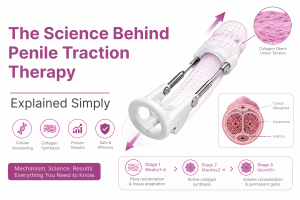
Most men see the word “cytokinesis” on a product page and assume it’s marketing language dressed up to sound scientific.
It isn’t.
Cytokinesis is a real, well-documented stage of cell division that sits at the center of how traction therapy produces structural tissue change. Understanding it separates men who use extenders intelligently from those who quit at week six because they expected faster results. Let’s discuss exactly what it is, how traction triggers it, and what that means practically for anyone considering a device.
What Exactly Is Cytokinesis and How Does It Differ From Other Types of Cell Division?
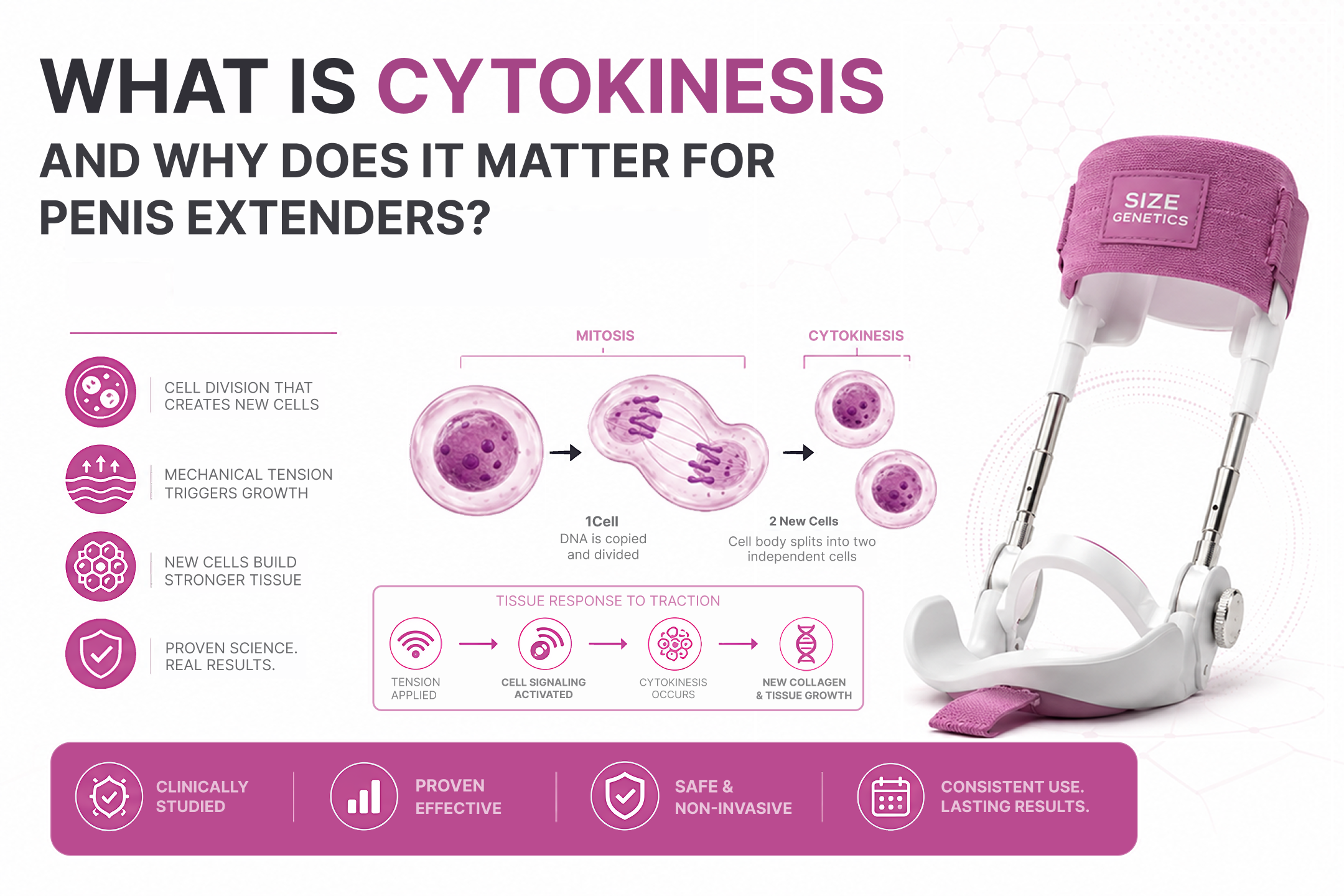
Cytokinesis is the physical splitting of one cell into two separate daughter cells. It is not the same as mitosis, and the difference matters.
| Process | What it handles | What it produces |
| Mitosis | The genetic side of division — copies DNA and separates it into two identical nuclei | One cell with two nuclei |
| Cytokinesis | The physical side of division — splits the cell body itself | Two independent, fully functional cells |
Without cytokinesis completing successfully after mitosis, you get a cell with two nuclei but no new cell count. What matters for tissue growth is that cytokinesis runs to completion — two functional cells where there was one.
In connective tissues like the penile tunica albuginea, cytokinesis is not a constant background event. Fibroblast cells spend most of their time in a resting state, producing collagen and maintaining the extracellular matrix at a maintenance pace. They enter active cell division only when a stimulus strong enough to override that resting state arrives.
Sustained mechanical tension is one of the most reliable biological triggers for that shift.
Why Does Mechanical Tension Trigger Cell Division in the First Place?
Because the body constantly monitors the structural integrity of its tissues — and responds when the load exceeds what current cell numbers can safely bear.
Sensors embedded in cell membranes, called mechanoreceptors, detect changes in the mechanical environment around a cell. When those sensors register sustained tension that exceeds what the current tissue architecture can handle, they send chemical signals into the nucleus that activate the cell cycle. This process is called mechanotransduction.
Here’s the cascade that follows:
- The activated cell progresses from resting state through DNA replication
- Mitosis divides the nucleus into two identical sets of genetic material
- Cytokinesis splits the cell body into two separate daughter cells
- If tension persists, those daughter cells face the same stimulus and may divide again
- Over weeks and months of daily traction sessions, this accumulates into a measurable increase in total connective tissue cells
A published in vitro study in the Journal of Sexual Medicine applied controlled mechanical strain directly to human tunica albuginea cells from both healthy tissue and Peyronie’s disease plaques. The strained cells showed significant structural reorganization, upregulation of metalloproteinase-8 (which removes disorganized scar tissue), and altered expression of key structural proteins compared to unstrained controls. The research team concluded it provided “good scientific evidence for the use of penile traction devices in Peyronie’s plaque remodeling.”
That’s a peer-reviewed finding from cell-level experimentation. Not a product company’s claim.
What Tissue Does Cytokinesis Actually Add in the Penis Extenders?
Cytokinesis adds new fibroblast cells to the tunica albuginea — and those cells immediately begin building new structural collagen.
The tunica albuginea is the dense fibrous outer sheath that wraps around the erectile chambers (corpora cavernosa). Its composition:
| Component | Share | Function |
| Collagen | 95% | Structural rigidity; organized in two interlocking layers |
| Elastin | 5% | Elasticity needed for erection |
When mechanotransduction activates fibroblast cytokinesis in this tissue, the new daughter cells don’t just add to cell count and stop. They enter a collagen synthesis mode:
- Produce new collagen fibers
- Align those fibers along the axis of mechanical strain
- Deposit them into the extracellular matrix
A 2018 dermal fibroblast study published in Nature confirmed that tissue expansion follows a two-phase sequential process — first rapid fibroblast proliferation through cytokinesis, then high-output collagen production filling the expanded tissue volume with structural material.
The result: tunica albuginea that is physically longer, contains more cells, and is reinforced with new collagen organized in the direction of traction. This is why gains from properly executed protocols are considered permanent. They reflect an actual change in the architectural content of the tissue — not a temporary elastic deformation that springs back when the load is removed.
How Is This the Same Principle Surgeons Use to Grow Bone and Skin?
Traction-driven cytokinesis is not unique to penile tissue. It is a fundamental biological law that applies wherever sustained tension is applied to living tissue.
Two medical fields have relied on this exact mechanism for decades:
Orthopedic surgery — the Ilizarov bone-lengthening technique A bone is cut and the two segments are slowly pulled apart by roughly 1 mm per day. Rather than creating a gap that fails to heal, the body fills the distraction zone with new bone cells generated through cytokinesis, eventually forming a complete ossified bridge. Ilizarov called this the “law of tension stress” — gradual, sustained traction on living tissue activates the regeneration of that tissue along the axis of applied force.
Reconstructive surgery — tissue expansion A silicone balloon implanted under the skin is inflated incrementally over 6 to 12 weeks. The skin does not thin and tear — it grows thicker and wider as fibroblasts undergo cytokinesis and deposit new collagen in response to the sustained load. The expanded skin is then used for grafts in burn reconstruction, post-mastectomy breast reconstruction, and scalp repair.
Penile traction applies this exact principle to the tunica albuginea and surrounding connective tissue. The device is not doing something exotic. It is exploiting a biological growth response that surgeons have relied on for decades in other body regions.
How Long Does Cytokinesis Take to Produce Visible Results?
A single fibroblast completes one full cell cycle — including mitosis and cytokinesis — in approximately 24 to 48 hours under ideal conditions. In living tissue under mechanical stress, the rate is slower, modulated by available oxygen, growth factors, and nutrient supply.
One day’s worth of cytokinesis events does not produce enough new cells to create macroscopic tissue change. The process requires weeks of repeated mechanical stimulation to accumulate a critical mass of new cells and new collagen that registers as measurable growth.
| Period | What is happening biologically | What users typically notice |
| Weeks 1 to 4 | Mechanotransduction activates; fibroblasts begin entering the cell cycle; minimal cytokinesis accumulated | Adaptation to wearing; possible early flaccid hang improvement from better blood flow |
| Months 2 to 3 | Cytokinesis accumulation reaches threshold for measurable tissue change; collagen synthesis intensifies | Early measurable increases in stretched length; improved erection quality in some users |
| Months 4 to 6 | Tissue remodeling consolidates; new collagen organizes structurally along the traction axis | Clear length gains; landmark studies using this window report statistically significant increases |
| Months 6 to 12 | Full structural consolidation; gains become progressively more durable | Most documented gains in clinical follow-up data; results persist after stopping |
The Italian clinical study cited across urology literature found that men who wore a penile traction device for 4 to 6 hours per day over six months recorded a 32% increase in flaccid length and a 36% improvement in erectile function scores by 12 months. The biology behind those outcomes was cytokinesis-driven fibroblast proliferation followed by aligned collagen synthesis, running continuously across hundreds of cumulative traction hours.
What Device Specifications Actually Support the Cytokinesis Process?
Not every extender applies tension correctly. The cytokinesis cascade only activates within a specific range of mechanical stimulus.
| Tension level | Effect on tissue |
| Below activation threshold | Mechanotransduction fails to initiate; no growth factor signaling cascade |
| 900 to 2,800 grams (validated range) | Fibroblast activation and cytokinesis occur without tissue damage |
| Above 2,800 grams | Mechanical stimulus shifts from a growth signal to an injury signal; fibrotic repair response instead of healthy tissue growth |
Two specifications matter most in practice:
Calibrated tension delivery A device must produce a measurable, adjustable force output — not an approximate stretch. SizeGenetics is rated to deliver up to 2,800g of calibrated traction and is an FDA-registered Class II medical device manufactured by Danamedic ApS. The Jes-Extender, also manufactured by Danamedic and available since 1995, operates on the same principle — calibrated force applied consistently along the penile axis over extended wear periods. Both allow users to start at lower tension levels and progress incrementally, exactly how clinical protocols structure the cytokinesis cascade without injury.
Comfort system that makes daily hours achievable A device that causes pain or slipping after 90 minutes cannot accumulate the 4 to 6 daily hours clinical studies used to produce results. SizeGenetics incorporates a 58-way comfort system to extend wearable session lengths. Jes-Extender offers a silicone comfort strap system for the same purpose. These are not cosmetic features. They are what make the biological protocol achievable in practice.
Does Cytokinesis Explain Why Gains Are Permanent After Stopping?
Yes. This is the most important practical implication of the mechanism.
Gains from traction therapy are considered permanent because new cells produced through cytokinesis do not dissolve or disappear when the device comes off. They integrate into the tissue architecture, produce collagen, and maintain the structural mass of an expanded tunica albuginea. Structurally identical to why expanded skin used in reconstructive surgery stays expanded after the tissue expander is removed — the new cells are real tissue, not swelling.
Clinical follow-up data confirms this:
- A systematic review covering results from over 1,000 patients in 15 major penile traction trials confirmed improvements persisted at follow-up in all studies that included post-treatment measurement
- The RestoreX randomized controlled trial documented that curvature and length improvements in Peyronie’s disease patients were maintained at 9-month follow-up without ongoing device use
One nuance worth being direct about:
| Gain type | Source | Stability after stopping |
| Early flaccid hang and erectile quality improvements | Partly vascular — improved blood flow from mechanical stimulation | Can partially regress if stopped before month 4 to 6 |
| Length gains from months 6 to 12 | Structural — cytokinesis-driven new tissue with mature collagen | Predominantly permanent |
Harsh but true: men who stop before the 4 to 6 month mark are stopping before structural consolidation has run its course.
What Happens to Cytokinesis When Sessions Are Skipped or Tension Is Too Low?
The cascade stops. And restarting it costs you more time than the gap itself.
Fibroblasts in the tunica albuginea are not actively dividing by default. They need a minimum threshold of mechanical force delivered with sufficient frequency to stay in an active proliferative mode.
What skipping sessions actually does:
- Drops the cumulative mechanical signal below the activation threshold
- Fibroblasts shift back to their resting state
- Collagen synthesis reduces and cell division pauses
- When use resumes, the first week or two returns cells to the proliferative state they were already in — rather than continuing to build forward
What under-tensioning does:
- Provides a physical stimulus but not one strong enough to initiate the growth factor signaling cascade
- Mechanoreceptors activate at a minimum threshold — below that, traction hours accumulate without biological effect
- A correctly calibrated device used at proper tension for 4 to 6 hours daily outperforms a poorly fitted device used for 8 hours
Compliance drives outcomes more than device quality. The biology is unforgiving about this.
Does Cytokinesis Explain Blood Flow Improvements Too?
Yes — and this is the angle most traction content ignores entirely.
Research into the molecular effects of penile traction found that mechanical stimulation upregulates endothelial nitric oxide synthase (eNOS) in cavernosal tissue. eNOS is the enzyme responsible for producing nitric oxide — the gas that relaxes smooth muscle in blood vessel walls and allows the erectile chambers to fill with blood. Reduced eNOS activity is a major mechanism in both age-related and vascular erectile dysfunction.
The connection to cytokinesis:
- Fibroblasts and endothelial cells in penile tissue are closely linked
- Research from the Karolinska Institute found that fibroblasts, stimulated by the mechanical environment around them, regulate blood flow to erectile tissue by modulating vascular tone
- When cytokinesis increases the number of these cells and traction activates their eNOS-related signaling pathways, the result is not just more tissue volume but better-functioning vascular infrastructure within that tissue
This is why the Italian clinical study reported a 36% improvement in erectile function scores alongside the 32% increase in flaccid length. The two outcomes are connected at the cellular level. A device driving cytokinesis in the tunica albuginea is simultaneously improving the vascular architecture responsible for erections.
What Is the Clearest Way to Explain Why Traction Outperforms Every Other Non-Surgical Option?
Traction wins on mechanism specificity. Every other option either has no pathway to cytokinesis or produces no new tissue at all.
| Method | Pathway to cytokinesis | New tissue generated | Clinical evidence |
| Pills and supplements | None — mechanotransduction requires physical force, not an orally ingested compound | No | No credible evidence for permanent enlargement (Mayo Clinic) |
| Surgery (ligamentolysis) | None — cuts suspensory ligament to expose existing internal shaft | No | Structural change, but no new tissue; erection angle permanently altered |
| Penile traction therapy | Complete chain — tension activates mechanoreceptors, initiates growth factor signaling, drives cytokinesis, produces new collagen | Yes | Multiple independent RCTs and systematic reviews |
The complete mechanistic chain for traction:
- Applied tension activates mechanoreceptors
- Mechanoreceptors initiate growth factor signaling
- Growth factor signaling drives fibroblast cytokinesis
- Cytokinesis produces new cells
- New cells synthesize new collagen
- New collagen physically elongates the tunica albuginea
Each step in that chain has independent scientific support. The end result — modest but real and permanent length gain — has been documented in multiple independent clinical trials.
That is what separates the biology of traction from the rest of the male enhancement market. Not a claim. A complete and verifiable mechanism of action.